简体中文
简体中文


Maximización de la eficiencia en sistemas de precipitadores electrostáticos.
INICIO / NOTICIAS / Noticias de la industria / Maximización de la eficiencia en sistemas de precipitadores electrostáticos.
 Por administrador
Las instalaciones industriales en todo el mONUdo enfrentan el desafío persistente de gestionar las partículas en suspensión en el aire. La eficiencia de los sistemas de recolección de polvo impacta directamente en los costos operativos, el cumplimiento ambiental y la salud de la fuerza laboral. ONU Precipitador electrostático ESP representa ONUa de las tecnologías más efectivas disponibles para capturar partículas finas de las corrientes de escape antes de que ingresen a la atmósfera.
A diferencia de los métodos tradicionales de filtración mecánica, los sistemas electrostáticos funcionan según un principio completamente diferente. Utilizan campos eléctricos para cargar partículas y atraerlas a placas de recolección, ofreciendo un rendimiento superior para partículas de polvo ultrafinas que otros sistemas tienen dificultades para capturar. Esta tecnología ha evolucionado significativamente en las últimas décadas y se ha vuelto cada vez más esencial para las instalaciones que procesan materiales que van desde polvo de cemento hasta vapores metálicos.
un precipitador electrostático Funciona a través de un proceso sistemático que separa el polvo de las corrientes de gas con notable eficiencia. Comprender estos principios ayuda a los administradores de instalaciones a apreciar por qué esta tecnología supera consistentemente a los enfoques alternativos de recolección de polvo.
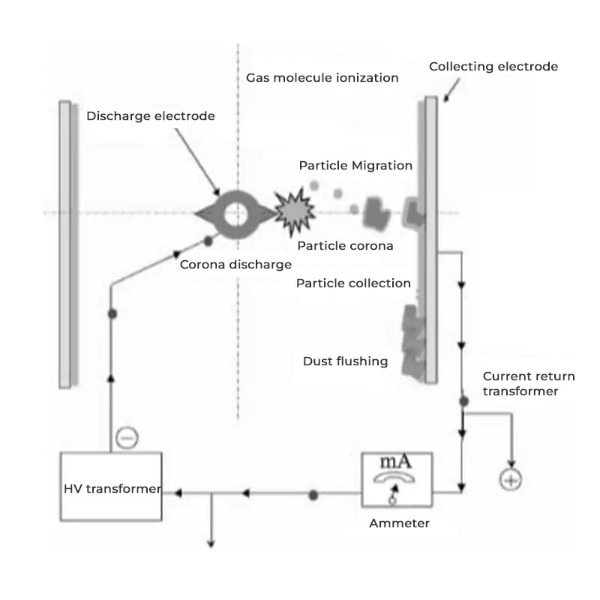
El sistema comienza cuando el gas contaminado ingresa a la cámara de recepción. Un electrodo primario, mantenido a alto tensión (normalmente entre 40.000 y 100.000 voltios), crea una descarga en corona. Este campo eléctrico ioniza las moléculas de gas, generando electrones libres que se adhieren a las partículas de polvo suspendidas. Las partículas cargadas luego migran hacia las superficies de recolección debido al gradiente del campo eléctrico.
Una vez cargadas, las partículas se mueven hacia electrodos de recolección con cargas opuestas, generalmente placas o tubos grandes. Esta migración se produce independientemente de la velocidad del gas, lo que representa una ventaja fundamental frente a los sistemas de filtración mecánica. Las partículas continúan moviéndose hacia las superficies de recolección incluso si la corriente de gas se acelera, lo que garantiza una captura constante independientemente de las variaciones del caudal.
Las partículas recolectadas se acumulan en las superficies de los electrodos hasta que la capa se vuelve demasiado espesa para mantener la eficiencia eléctrica. En este punto, los golpes mecánicos (vibración controlada de los electrodos) desalojan la torta de polvo, permitiendo que las partículas caigan en tolvas para su eliminación. Los sistemas modernos emplean múltiples estrategias de golpeo para optimizar tanto la recolección como la prevención del reingreso.
Los sistemas secos representan la configuración más común para aplicaciones industriales. Operan sin humedad adicional y son adecuados para instalaciones que manejan partículas secas, como polvo de operaciones de molienda, producción de cemento o manipulación de materiales. Estos sistemas consumen una cantidad mínima de agua y no generan problemas de eliminación de lodos, lo que los hace económicamente atractivos para muchas operaciones industriales.
Los ajustes húmedos introducen un rocío líquido en la zona de recolección, que cumple múltiples funciones. El líquido lava las partículas recogidas de los electrodos, evita que las partículas vuelvan a arrastrarse y enfría la corriente de gas. Los sistemas húmedos destacan en aplicaciones que involucran partículas pegajosas, materiales corrosivos o situaciones en las que los equipos posteriores no pueden tolerar ningún arrastre de partículas.
un sistema ESP industrial Se pueden configurar como diseños tipo placa o tipo tubo. Los sistemas tipo placa cuentan con placas recolectoras paralelas y ofrecen espacios compactos con alto eficiencia de recolección. Los diseños tipo tubo proporcionan más superficie dentro de espacios idénticos y manejan mayores volúmenes de gas, aunque presentan requisitos de mantenimiento más complejos.
La resistividad eléctrica de las partículas afecta principalmente la eficiencia de la recolección. Las partículas de baja resistividad (por debajo de 10^8 ohm-cm) pierden su carga demasiado rápido, lo que reduce la eficacia de la recolección. Las partículas de alta resistividad (por encima de 10^11 ohm-cm) retienen una carga excesiva, lo que provoca que se vuelvan a arrastrar desde las superficies de recolección. El rango óptimo suele estar entre 10^8 y 10^11 ohm-cm, donde la carga y retención de partículas alcanzan la máxima eficiencia. Los operadores de las instalaciones deben comprender la composición específica de sus partículas para predecir con precisión el rendimiento del sistema.
La velocidad del gas a través de la zona de recolección afecta directamente el tiempo de residencia de las partículas. Las partículas requieren tiempo suficiente para migrar a las superficies de recolección antes de salir del sistema. Las velocidades de cara típicas varían de 3 a 5 metros por segundo para los sistemas convencionales, aunque algunos diseños avanzados operan a velocidades más altas sin sacrificar la eficiencia de recolección. La uniformidad de la distribución del flujo en toda el área de recolección se vuelve crítica: las zonas muertas o regiones turbulentas permiten que las partículas eviten las superficies de recolección.
La distancia entre los electrodos de descarga y de recolección influye en la intensidad del campo eléctrico y la velocidad de migración de partículas. Un espaciado más cercano crea campos más fuertes pero aumenta el riesgo de falla eléctrica. El espaciado óptimo equilibra la intensidad del campo con la estabilidad operativa, y normalmente oscila entre 100 y 300 milímetros, según la aplicación específica y la filosofía de diseño. La alineación y el mantenimiento de los electrodos afectan directamente la consistencia del rendimiento.
La temperatura, la humedad y la composición del gas influyen sustancialmente en el funcionamiento del precipitador electrostático. El aumento de las temperaturas reduce la densidad del gas y aumenta la conductividad eléctrica, lo que puede provocar chispas. Los niveles de humedad superiores al 15 por ciento pueden precipitar compuestos corrosivos en las superficies de los electrodos, lo que reduce la eficiencia. Los componentes de gases ácidos o alcalinos requieren materiales de electrodos especializados para evitar la corrosión.
| Parámetro | rango optimo | Impacto en el rendimiento |
|---|---|---|
| Velocidad del gas | 3-5 m/s | Determina el tiempo de residencia y la eficiencia. |
| Temperatura de funcionamiento | Por debajo de 160 grados centígrados | Mantiene la estabilidad eléctrica y la carga de partículas. |
| Voltaje del electrodo | 40.000-100.000 voltios | controlara la ionización y la carga de partículas. |
| humedad relativa | Por debajo del 15 por ciento | Previene la suciedad y la corrosión de los electrodos. |
La tolva de recolección representa un componente crítico que a menudo se pasa por alto en la optimización del sistema. La acumulación de polvo en las tolvas puede llegar a formar puentes, creando huecos que impiden el flujo de partículas y provocando un golpeteo excesivo de los electrodos. Las modernas instalaciones emplean sensores de nivel, vibradores y sistemas de descarga automatizados para mantener condiciones óptimas de la tolva. Las inspecciones periódicas garantizan que el polvo almacenado no sufra cambios químicos ni se forma torta que impida su eliminación.
La intensidad y frecuencia del golpeteo de los electrodos afectan dramáticamente tanto la eficiencia de recolección como la longevidad del sistema. Un golpe insuficiente deja capas de partículas que bloquean las zonas de carga y reducen la eficiencia. Los golpes excesivos causan daños prematuros a los electrodos y aumentan el reingreso de las partículas recolectadas. Los sistemas avanzados emplean controles de golpeteo inteligentes que ajustan la intensidad según los patrones de voltaje de los electrodos en tiempo real, adaptándose automáticamente a las condiciones cambiantes de la entrada.
Un colector de polvo electrostático se integra perfectamente con los equipos de control de emisiones posteriores. Los sistemas secundarios que capturan cualquier partícula que escape del colector primario incluyen etapas de filtrado adicionales, sistemas de bolsas o etapas electrostáticas adicionales. Este enfoque de múltiples etapas garantiza que las emisiones finales cumplan con regulaciones ambientales cada vez más estrictas manteniendo al mismo tiempo la eficiencia económica.
El mantenimiento preventivo extiende la vida útil del precipitador electrostático y mantiene la máxima eficiencia durante todo el ciclo de vida del equipo. Las actividades críticas de mantenimiento incluyen:
Inspección trimestral de alineación y condición de los electrodos.
Medición semestral de patrones de corriente y voltaje de descarga.
Imágenes térmicas no anuales para detectar puntos calientes o anomalías eléctricas.
Reemplazo bienal de componentes de golpeo desgastados.
Monitoreo continuo de los sistemas de descarga de tolvas.
controlar periódico de los sistemas de aislamiento eléctrico.
Los sistemas electrostáticos logran eficiencias de recolección que superan el 99 por ciento para partículas en el rango de 1 a 10 micrómetros, exactamente el rango de tamaño con el que más lucha la filtración mecánica. Esta capacidad elimina millas de toneladas de partículas finas que de otro modo escaparían a la atmósfera. La eficacia de la tecnología aumenta a medida que disminuye el tamaño de las partículas, a diferencia de los sistemas mecánicos donde la eficiencia cae distribuida para las partículas ultrafinas.
Una vez instalados, los sistemas electrostáticos funcionan a un costo notablemente bajo en comparación con las alternativas. El consumo de energía depende principalmente de la generación del campo eléctrico, no de superar la resistencia del filtro como lo requieren los sistemas mecánicos. La caída de presión permanece esencialmente constante durante todo el ciclo de vida del sistema, lo que evita los crecientes costos de energía que afectan a los sistemas de filtros a medida que se desarrollan las tortas de filtración. Los costos operativos suelen ser en promedio entre un 30 y un 50 por ciento más bajos que los sistemas de filtración mecánica equivalentes durante un período de diez años.
El polvo acumulado sale del sistema seco y permanece en gran medida sin contaminar con fibras del medio filtrante o lodos. Esta característica simplifica la logística de eliminación y puede permitir la recuperación de materiales en determinadas aplicaciones. En comparación con los sistemas húmedos que generan lodos que requieren tratamiento de agua antes de su eliminación, las soluciones electrostáticas secas reducen sustancialmente los costos de remediación ambiental.
La ausencia de elementos filtrantes mecánicos elimina los ciclos de reemplazo que definen la economía de los filtros de mangas y de cartucho. Los electrodos, aunque son consumibles, normalmente funcionan durante 8 a 15 años antes de que sea necesario reemplazarlos. Esta vida operativa extendida entre eventos de mantenimiento importantes reduce el tiempo de inactividad y los gastos administrativos asociados con el servicio de equipos.
Las instalaciones de cemento generan volúmenes masivos de partículas finas durante toda la producción. Los escapes de hornos, los molinos y las operaciones de manipulación de materiales requieren un control agresivo del polvo. Un sistema de eliminación de polvo industrial que emplea tecnología electrostática captura el 99,9 por ciento de las emisiones, lo que permite que las instalaciones superen los estándares ambientales y al mismo tiempo recuperen el valioso polvo de cemento para su reutilización en los procesos de producción.
La fundición, el refinado y la producción de aleaciones de metales liberan diversas corrientes de partículas que contienen valiosos compuestos metálicos. Los sistemas electrostáticos capturan eficientemente estos materiales, permitiendo su recuperación para su reciclaje. La tecnología maneja aplicaciones de alta temperatura que obstruirían rápidamente los filtros mecánicos, manteniendo un rendimiento constante incluso cuando las temperaturas de entrada fluctúan.
Las plantas farmacéuticas y de productos químicos especializados requieren estándares de limpieza excepcionales. La tecnología electrostática elimina el polvo del producto y los subproductos del proceso con una contaminación mínima, cumpliendo con los requisitos de calidad de los materiales que se procesarán posteriormente. El método de recolección seca resulta especialmente valioso cuando la pureza del producto afecta directamente el rendimiento de fabricación.
Las centrales eléctricas de carbón y de biomasa han dependido de la tecnología electrostática durante décadas para controlar las emisiones de cenizas volantes. Las modernas instalaciones manejan enormes volúmenes de gas y al mismo tiempo mantienen la eficiencia de recolección por encima del 99 por ciento. La recuperación de cenizas permite la utilización de materiales en la producción de concreto y otras aplicaciones, creando flujos de ingresos a partir de subproductos.
Los molinos de cereales, las instalaciones de procesamiento de alimentos y la manipulación de productos agrícolas generan polvo fino que plantea problemas tanto para el medio ambiente como para la salud ocupacional. Los sistemas electrostáticos capturan estos materiales de manera efectiva, protegiendo la salud de los trabajadores y cumpliendo con los estándares de emisiones. La capacidad de la tecnología para manejar las variaciones de temperatura características de las operaciones agrícolas la hace especialmente adecuada para este sector.
Cuando la eficiencia de la recaudación cae por debajo de los niveles objetivo, es necesario investigar múltiples causas potenciales. La desalineación de los electrodos debido a vibraciones mecánicas o actividad sísmica puede alterar los patrones del campo eléctrico. La acumulación de una capa de polvo a pesar de los golpes normales sugiere que la tolva está obstruida o una descarga inadecuada. La deriva de los parámetros eléctricos, indicada por la disminución de la corriente de descarga, indica suciedad en la superficie del electrodo o partículas de alta resistividad que requieren ajustes eléctricos.
Los arcos eléctricos incontrolados entre electrodos reducen la eficiencia y pueden dañar permanentemente los componentes eléctricos. Las causas comunes incluyen picos de concentración de polvo en la entrada que exceden los parámetros de diseño, condensación de humedad en las superficies de los electrodos o contaminación de los electrodos por corrosión de las aguas arriba. La implementación de monitoreo de concentración de entrada, calentamiento de electrodos para evitar la condensación y control mejorado de la corrosión de las aguas arriba generalmente resuelve los problemas crónicos de chispas.
El polvo acumulado que se escapa de las superficies de los electrodos antes de llegar a las tolvas indica problemas en los parámetros de golpeteo o deterioro del campo eléctrico. Las partículas de alta resistividad pueden retener una carga excesiva, flotando lejos de las superficies de recolección a pesar de las fuerzas gravitacionales descendentes. Ajustar los parámetros eléctricos o modificar las propiedades de las partículas mediante un tratamiento químico previo a este desafío. En casos extremos, las etapas de recolección adicionales brindan un seguro contra violaciones de emisiones.
La pérdida acelerada de material del electrodo sugiere componentes de gas corrosivos, tensión eléctrica excesivamente alta o problemas de impacto de partículas. Los materiales de revestimiento de electrodos pueden resistir la corrosión química, aunque es posible que se requieran composiciones de electrodos especiales para condiciones de servicio severas. La optimización de la distribución del campo eléctrico mediante el refinamiento de la geometría de los electrodos o ajustes de espacio reduce el desgaste mecánico por el bombardeo de partículas.
El dimensionamiento adecuado del sistema comienza con una medición o estimación precisa de la carga de polvo de entrada: la masa de partículas que ingresan por unidad de tiempo. Esta cifra impulsa todas las decisiones de diseño posteriores, desde el área de los electrodos de recolección hasta la capacidad de la tolva. Los sistemas de tamaño insuficiente operan con penalizaciones de eficiencia y desgaste excesivo. Las instalaciones sobredimensionadas requieren inversiones de capital y aumentan los costos operativos debido al consumo innecesario de energía.
El área de recolección por unidad de caudal de gas (expresada como área de recolección por mil metros cúbicos por hora de gas) determina directamente la eficiencia de captura. El diseño típico oscila entre 5 y 15 metros cuadrados por mil metros cúbicos por hora, según las características de las partículas y los niveles de eficiencia objetivo. Las áreas de recolección más altas producen una mayor eficiencia pero aumentan el tamaño, el peso y el costo de capital del equipo. La óptima equilibra los requisitos de rendimiento con las restricciones económicas específicas de cada aplicación.
Los parámetros de diseño eléctrico deben adaptarse a la composición específica de las partículas y las propiedades del gas de cada aplicación. Las partículas de alta resistividad pueden requerir voltajes elevados para lograr una carga adecuada, aunque un voltaje excesivo corre el riesgo de provocar un arco. Por el contrario, las partículas de baja resistividad pueden funcionar eficientemente a voltajes más bajos, reduciendo la tensión de los componentes eléctricos. Las pruebas piloto o el modelado computacional ayudan a optimizar los parámetros eléctricos antes de la adquisición final del sistema.
Las aplicaciones que involucran componentes de gases ácidos o alcalinos requieren materiales especializados para prevenir la corrosión. Los electrodos estándar de acero dulce pueden sobrevivir sólo meses en servicio corrosivo, mientras que los electrodos especializados de acero inoxidable o con revestimiento cerámico duran años. La materiales tiene un impacto significativo en los gastos operativos durante la vida útil del sistema, lo que justifica una evaluación cuidadosa durante la fase de diseño.
Las innovaciones recientes emplean tecnología de pulsos de alto voltaje en lugar de excitación continua de corriente continua. La energización por pulsos reduce el consumo de energía promedio mientras mantiene características de carga superiores. Algunos diseños logran eficiencias de recolección comparables a los sistemas continuos con un consumo de energía eléctrica entre un 40 y un 60 por ciento menor, lo que crea una economía atractiva para instalaciones que se preocupan por la energía.
Los sistemas modernos incorporan redes integrales de sensores que brindan monitoreo del desempeño en tiempo real. La medición continua del voltaje de los electrodos, la corriente de descarga, las emisiones de salida y los niveles de la tolva permite el mantenimiento predictivo: el servicio se realiza antes de que se desarrollen los problemas y no después de que ocurran. Los algoritmos de inteligencia artificial analizan estos flujos de datos para optimizar los horarios de golpeo, los parámetros eléctricos y el tiempo de mantenimiento, reduciendo aún más los costos operativos.
La combinación de precipitación electrostática con filtración mecánica crea sistemas híbridos que capturan las ventajas de ambas tecnologías. La etapa electrostática elimina partículas ultrafinas mientras que la etapa mecánica captura partículas más grandes y brinda protección de respaldo. Estos sistemas logran emisiones de salida cercanas a miligramos de un solo dígito por metro cúbico normal, niveles que antes eran inalcanzables con la tecnología convencional de una sola etapa.
Los sistemas futuros enfatizan cada vez más la sostenibilidad ambiental más allá del simple control de emisiones. Las innovaciones en el diseño reducen el consumo de agua en sistemas electrostáticos húmedos, emplean materiales reciclados en la construcción e incorporan sistemas de recuperación de energía que capturan energía eléctrica a partir de procesos de recolección de alta eficiencia. Estos desarrollos alinean la tecnología electrostática con objetivos de sostenibilidad industrial más amplios.
El rendimiento exitoso del sistema comienza con las bases de instalación adecuadas. Los sistemas electrostáticos deben funcionar nivelados; las desviaciones que superan los 5 milímetros por metro pueden alterar los patrones del campo eléctrico y la recolección de partículas. Los sistemas de aislamiento de vibraciones protegen los componentes eléctricos sensibles de las vibraciones ambientales de las instalaciones. Las conexiones de los conductos requieren una alineación precisa para evitar el desperdicio de gas y garantizar una distribución uniforme del flujo en las zonas de recolección.
Los sistemas eléctricos de alto voltaje exigen consideraciones de seguridad excepcionales durante la instalación. Los interruptores de aislamiento, los sistemas de puesta a tierra y los mecanismos de parada de emergencia deben funcionar de manera confiable en todas las condiciones de operación. Las pruebas antes de la activación del sistema verifican que todos los componentes eléctricos funcionan dentro de las especificaciones de diseño y responden correctamente a las señales de control.
Los procedimientos de puesta en servicio establecen métricas de desempeño de referencia con las que se comparan las futuras operaciones. La medición de las emisiones de salida durante condiciones de entrada limpia proporciona la base de referencia de eficiencia. Los aumentos progresivos de la concentración de polvo de entrada verifican que el sistema mantiene la eficiencia del diseño en todo el rango operativo. Las pruebas de temperatura y caída de presión confirman que los supuestos de diseño mecánico y térmico resultan válidos durante el funcionamiento real.
Los operadores del sistema requieren una capacitación integral que abarque el funcionamiento normal, el monitoreo de parámetros, la resolución de problemas básicos y los procedimientos de emergencia. Los manuales de funcionamiento detallados y la documentación de mantenimiento específicos de cada instalación permiten una gestión eficaz a largo plazo. La capacitación de actualización periódica mantiene la competencia operativa a medida que ocurren cambios de personal.
Las regulaciones ambientales a nivel mundial establecen límites cada vez más estrictos a las emisiones de partículas industriales. La tecnología electrostática permite consistentemente el cumplimiento de los estándares actuales al tiempo que proporciona márgenes de seguridad para futuros ajustes regulatorios. Un moderno colector de polvo electrostático logra habitualmente emisiones de salida inferiores a 50 miligramos por metro cúbico normal, niveles muy por debajo de la mayoría de los estándares medioambientales internacionales.
Las emisiones de polvo industrial contribuyen sustancialmente a la contaminación del aire ambiente y a los efectos asociados sobre la salud respiratoria. Los sistemas electrostáticos evitan que millas de toneladas de partículas entren a la atmósfera anualmente en las principales regiones industriales. Este impacto colectivo se traduce en mejoras mensurables en la calidad del aire de la comunidad y en una reducción de las cargas sanitarias derivadas de las enfermedades relacionadas con la contaminación.
La captura de los gases de escape antes de su emisión a la atmósfera evita que los trabajadores se expongan a las nubes de polvo características de las descargas incontroladas. La mejora de la calidad del aire en las instalaciones reduce las enfermedades respiratorias ocupacionales, disminuye el ausentismo y mejora la productividad general de los trabajadores. Estas mejoras de seguridad proporcionan beneficios que van mucho más allá del simple cumplimiento normativo.
Muchos procesos industriales liberan materiales valiosos en el polvo de escape. La recolección electrostática preserva estos materiales en forma seca, relativamente pura y susceptible de reciclaje. El polvo de aluminio recuperado, los compuestos que contienen metales y otros subproductos generan flujos de ingresos al tiempo que reducen los requisitos de minería y producción primaria. Esta eficiencia de recursos se alinea con los principios de la economía circular cada vez más valorados por los fabricantes conscientes del medio ambiente.
Los costos iniciales de equipo e instalación para sistemas electrostáticos varían sustancialmente según los requisitos del área de recolección y la complejidad de la aplicación. Los sistemas más pequeños que sirven líneas de procesamiento individuales pueden costar entre $ 50 000 y $ 150 000 instalados. Los grandes sistemas integrados que atienden múltiples procesos o gestionan cargas extremas de polvo pueden alcanzar varios millones de dólares. A pesar de los costos de capital aparentes más altos que algunas alternativas mecánicas, la eficiencia y durabilidad superiores crean una economía favorable a largo plazo.
El consumo de energía eléctrica representa el mayor coste operativo recurrente. Los sistemas modernos suelen consumir de 5 a 15 kilovatios por cada mil metros cúbicos por hora de volumen de gas tratado. En comparación con los sistemas de filtros donde el consumo de energía aumenta dramáticamente a medida que se desarrollan los revoques, los sistemas electrostáticos mantienen una demanda de energía constante durante todo el ciclo de vida. Los costos operativos adicionales incluyen el reemplazo de electrodos, materiales de mantenimiento y piezas de reparación ocasionales, generalmente entre el 3 y el 8 por ciento del costo del equipo anual.
La comparación de los costos del ciclo de vida con las alternativas de filtros mecánicos revela que los sistemas electrostáticos generalmente se recuperan en un plazo de 3 a 5 años gracias a la reducción de los gastos operativos. La vida útil prolongada del equipo (de 15 a 25 años para sistemas con buen mantenimiento) crea valor adicional a través de décadas de servicio confiable más allá del período de recuperación. Las instalaciones que requieren una eficiencia de cobranza excepcional pueden obtener retornos aún más rápidos cuando las tecnologías alternativas no pueden cumplir con los requisitos de rendimiento a un costo razonable.
Más allá de los costos directos de los equipos, los sistemas electrostáticos reducen los gastos auxiliares, incluida la eliminación de filtros, el tratamiento de lodos en sistemas húmedos y las reparaciones de emergencia por fallas prematuras del filtro. Las mejoras en el cumplimiento ambiental pueden reducir los costos de los permisos, el riesgo de multas y las primas de seguros en jurisdicciones donde las violaciones de emisiones generan sanciones severas. Estos beneficios indirectos, si bien son más difíciles de cuantificar, a menudo superan los ahorros operativos directos.
Los sistemas electrostáticos modernos logran consistentemente eficiencias de recolección del 99 al 99,9 por ciento en toda la gama de tamaños de partículas, desde ultrafinas hasta gruesas. Esto significa que por cada diez mil partículas que entran en el sistema, sólo entre diez y cien escapan a la atmósfera. La eficiencia varía según las características de las partículas, los parámetros eléctricos y el diseño del sistema, pero los sistemas bien mantenidos rara vez caen por debajo del 99 por ciento de eficiencia durante su vida útil operativa.
Los electrodos de descarga y recolección suelen funcionar durante 8 a 15 años antes de que sea necesario reemplazarlos. La vida útil real depende de la concentración de polvo de entrada, la resistividad de las partículas, la temperatura de funcionamiento y la calidad del mantenimiento. Algunas instalaciones experimentan una vida útil de los electrodos que supera los 20 años, mientras que otras que operan en condiciones extremas pueden requerir reemplazo cada 5 a 7 años. El mantenimiento preventivo, incluida la limpieza periódica y la inhibición de la corrosión, prolonga sustancialmente la vida útil del electrodo.
Los sistemas electrostáticos estándar funcionan eficazmente hasta aproximadamente 160 grados Celsius. Más allá de esta temperatura, la densidad del gas disminuye, la conductividad eléctrica aumenta y el riesgo de chispas aumenta sustancialmente. Sin embargo, los sistemas especializados de alta temperatura que utilizan materiales de electrodos y estrategias de control específicas pueden manejar corrientes de escape a 300 grados Celsius o más. La consulta de diseño para aplicaciones específicas garantiza la selección adecuada del sistema para servicio de alta temperatura.
El mantenimiento de rutina incluye inspecciones visuales trimestrales del estado y alineación de los electrodos, mediciones semestrales de los parámetros operativos eléctricos y monitoreo continuo de los sistemas de descarga de la tolva. El mantenimiento anual implica imágenes térmicas para detectar anomalías eléctricas, medición de la caída de presión del sistema y verificación del funcionamiento del sistema de control. El reemplazo preventivo de componentes antes de fallas evita paradas de emergencia y mantiene un rendimiento constante. Un programa integral de mantenimiento preventivo normalmente requiere de 40 a 60 horas de mano de obra calificada al año para sistemas a escala industrial.
La resistividad eléctrica de las partículas determina esencialmente la eficacia con la que las partículas retienen la carga y migran a las superficies de recolección. El rendimiento óptimo se produce cuando la resistividad de las partículas cae entre 10^8 y 10^11 ohm-cm. Por debajo de 10^8 ohm-cm, las partículas pierden su carga demasiado rápido. Por encima de 10^11 ohm-cm, las partículas retienen una carga excesiva y se repelen de las superficies de recolección. Comprender la resistividad de las partículas de aplicaciones específicas durante el diseño del sistema garantiza que los parámetros eléctricos se puedan optimizar para lograr la máxima eficiencia.
Los sistemas tipo placa emplean placas colectoras paralelas con electrodos de descarga suspendidos entre ellas. Ofrecen un diseño compacto y un acceso de mantenimiento sencillo. Los sistemas tipo tubo cuentan con tubos colectores cilíndricos con electrodos de descarga centrales. Los tubos proporcionan más superficie de recolección dentro de un espacio de piso equivalente, acomodando mayores volúmenes de gas. Los diseños de tubos presentan desafíos de mantenimiento y golpeo más complejos, pero destacan en aplicaciones con limitaciones de espacio. La selección depende del diseño de las instalaciones, los requisitos de volumen de gas y la capacidad de mantenimiento.
La tecnología electrostática se adapta a aplicaciones donde la captura de partículas finas es crítica, los costos operativos deben minimizarse durante la vida útil del equipo y existen limitaciones de espacio. La tecnología sobresale para partículas que requieren recuperación, materiales con alta resistividad para la limpieza del filtro y situaciones donde la consistencia de la caída de presión es esencial. Por el contrario, las aplicaciones que generan materiales extremadamente pegajosos o vapores corrosivos pueden requerir diseños electrostáticos húmedos o sistemas híbridos. La evaluación de ingeniería de los requisitos de aplicaciones específicas determina la selección de tecnología óptima.
Los sistemas eléctricos de alto voltaje requieren protocolos de seguridad integrales que incluyen procedimientos de aislamiento de energía, sistemas de apagado de emergencia, conexión a tierra adecuada y capacitación del personal. Existe peligro de descarga eléctrica incluso cuando el equipo parece inactivo, ya que la carga almacenada en los componentes eléctricos presenta peligro. Las instalaciones deben implementar procedimientos de bloqueo y etiquetado, limitar el acceso a zonas de alto voltaje y realizar capacitación de seguridad periódica para el personal. El mantenimiento adecuado de los sistemas eléctricos y el cumplimiento de los códigos eléctricos garantizan un funcionamiento seguro durante toda la vida útil del equipo.
La temperatura afecta significativamente el rendimiento, ya que las temperaturas elevadas reducen la densidad del gas y aumentan la conductividad eléctrica. La humedad superior al 15 por ciento puede crear ambientes corrosivos en las superficies de los electrodos. La composición del gas de entrada que contiene dióxido de azufre, óxidos de nitrógeno u otras especies químicas puede crear condiciones ácidas que requieren materiales de electrodos especializados. La altitud de la ubicación de las instalaciones afecta la densidad del gas y el rendimiento eléctrico. El diseño adecuado del sistema tiene en cuenta todas las condiciones ambientales previstas para mantener un rendimiento constante durante toda la vida operativa.
Los sistemas electrostáticos modernos habitualmente logran emisiones de salida por debajo de 50 miligramos por metro cúbico normal. Los diseños avanzados que incorporan múltiples etapas de recolección o tecnología híbrida pueden lograr emisiones de salida por debajo de 10 miligramos por metro cúbico normal. Las emisiones de salida de un solo dígito de miligramos por metro cúbico normal colocando a la tecnología electrostática entre los métodos de recolección de polvo más capaces disponibles. Estos niveles de desempeño superan la mayoría de los estándares ambientales internacionales y brindan márgenes de seguridad para futuros ajustes regulatorios.